Innovation
Very few organizations have an idea problem. What they usually lack is a reliable way to find out, quickly and cheaply, which ideas are worth pursuing—and the discipline to stop the ones that are not. Innovation done well is less about creativity than about tight feedback loops: frame the bet clearly, run the cheapest test that could disprove it, and let the evidence decide what gets funded next. We work alongside product and engineering teams to build that loop, then use it to take a small number of ideas all the way through to something real, supported and in the hands of users.
When an idea needs AI, sovereign deployment, or a custom product stack, we connect that bet to the right capability in Explore what's possible—without letting technology choice replace problem framing.
- Product Discovery & Framing
- Turning a vague ambition into a testable problem statement—user research, jobs to be done, and a clear articulation of what would have to be true for the idea to work.
- Rapid Prototyping
- Clickable and functional prototypes in days rather than quarters, put in front of real users early, so the expensive decisions get made on evidence instead of on the loudest opinion in the room.
- Proof of Concept to Production
- The unglamorous engineering that separates a working demo from a supportable product—observability, failure modes, cost modelling, security review and a team that can operate it on a Tuesday.
- Zero-to-One Product Builds
- Standing up new products and internal ventures end to end, with the smallest team that can credibly ship, and a scope deliberately narrow enough to reach real users quickly.
- Innovation Operating Model
- Establishing how ideas get funded, staged and stopped—stage gates, explicit decision criteria, and the organizational permission to kill work that has not earned its next round.

From Idea to Evidence in Weeks
The purpose of an early experiment is not to succeed—it is to find out. That distinction changes how the work is designed. An experiment built to succeed gets defended; an experiment built to inform gets answered and closed. We structure innovation work so that each stage produces a decision rather than a status update, and so that stopping is an ordinary, respectable outcome rather than an admission of failure.
How we structure the work:
- Frame the Bet: Before anything is built, we write down what would have to be true for this to work—and which of those assumptions is both most uncertain and most damaging if wrong.
- Cheapest Test First: The riskiest assumption gets tested with the least expensive instrument that can genuinely disprove it, which is often a prototype, a landing page or ten conversations rather than a build.
- Time-Boxed Spikes: Exploration runs in fixed windows with a defined question. When the window closes, the question gets answered, even if the answer is inconclusive.
- Evidence Gates: Each stage ends in an explicit decision—kill, persevere, or scale—against criteria agreed before the work started rather than negotiated after the results arrive.
- Production Readiness as a Choice: The step from prototype to product is planned and funded deliberately, not discovered when a pilot quietly becomes load-bearing.
The patterns that quietly kill innovation programmes:
Each one is comfortable in the moment. Together they produce a portfolio that is busy, expensive, and unable to say what it has learned.
- The Perpetual Pilot: Initiatives that neither scale nor stop, consuming budget and attention indefinitely because no one is empowered to end them.
- Demo-Driven Development: Building toward an impressive showcase rather than a real workflow, so the hard parts—error states, edge cases, integration—are deferred until they are fatal.
- Solutions Seeking Problems: Starting from an interesting technology instead of a costly, well-understood user problem, then searching for somewhere to apply it.
- Innovation Theatre: A lab disconnected from the operating business, producing artefacts nobody in the P&L has any obligation to adopt.
- No Kill Criteria: Success measures defined only after results are in, which makes every outcome look like partial progress and nothing ever conclusive.
DevCentral: Our Own First Customer
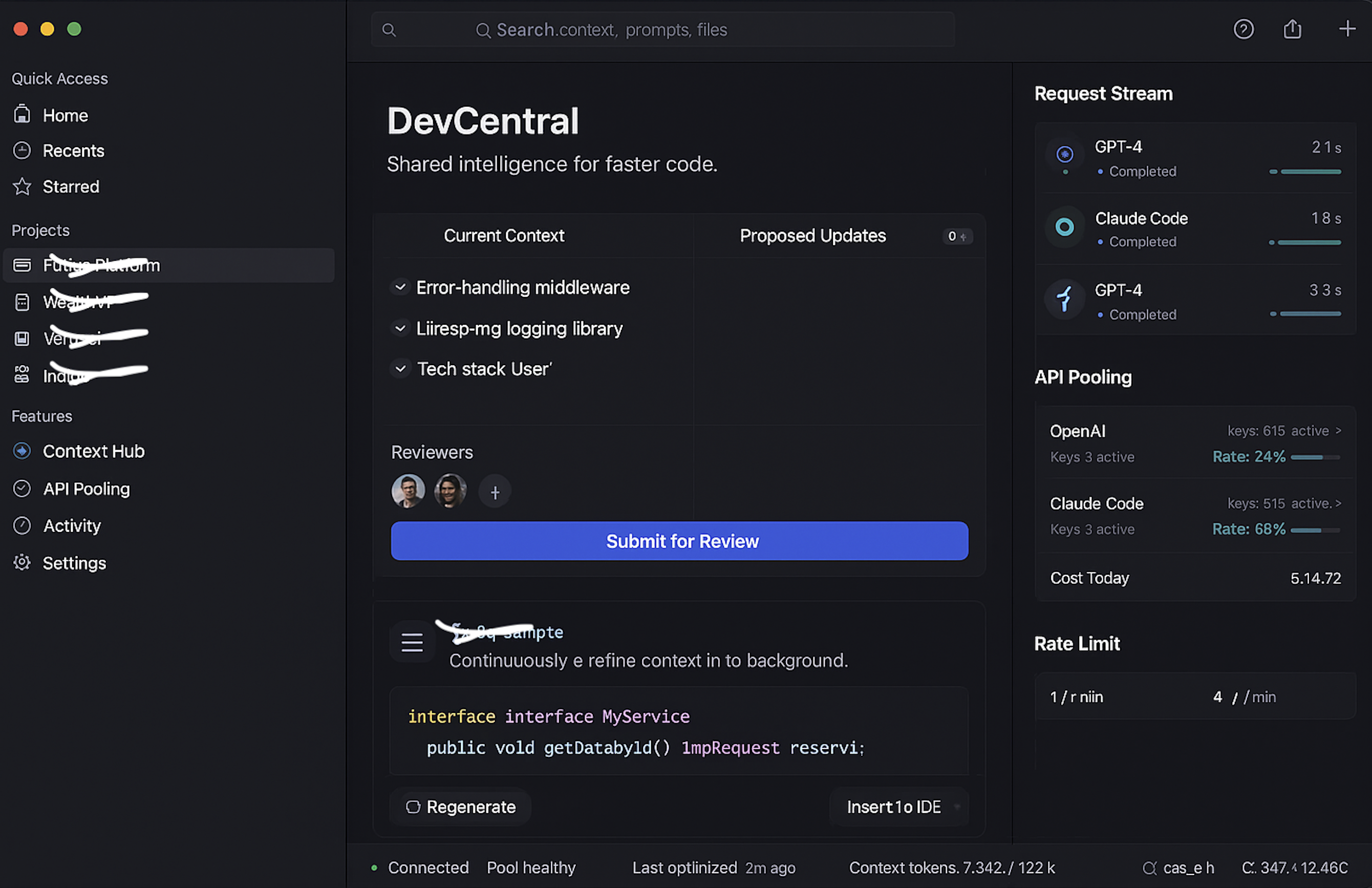
The clearest test of an innovation practice is whether it works on your own problems. DevCentral began as an internal frustration: our teams had adopted AI coding tools enthusiastically, but every developer worked in isolation—separate prompts, separate context, separate API keys, and no shared view of what any of it was costing or producing.
What we built, and what it taught us:
- Context Hub: Shared, curated project context that every developer draws from, so the model starts from what the team already knows rather than from whatever each person remembered to paste.
- API Pooling: Pooled access across providers with visible per-model usage, rate limits and daily cost—turning AI spend from an untracked line item into something a team can actually manage.
- Integrated Where Work Happens: Delivered into everyday development tools rather than as another destination, because adoption is decided by friction, not by features.
- Dogfooded First: We ran it on our own delivery teams long before we described it as a product, which is the fastest way to find out which of your assumptions were wishful.
GNIS AI: When the Constraint Is the Product
The organizations with the most valuable document estates were often the ones least able to use cloud AI on them. The blocker was residency, not model quality. Designing for the perimeter first became the product constraint—and that is how GNIS took shape. The innovation lesson still matters here: start from the hard constraint, not from a technology looking for a home.
What the constraint taught us:
- Design for the blocker first: If compliance will never approve outbound inference, build the architecture that removes that objection.
- Industry context compounds: Models trained on real corpora outperform generic assistants adapted after the fact.
- Own the learning loop: Weights and corrections should stay with the enterprise, not only with a rented service.
- Ship one workflow to production: Breadth comes after a single high-leverage path is proven inside the perimeter.
Explore related platforms & technologies
When an innovation bet needs a delivery stack, connect it to the right AI, custom application, or platform capability.
Want to cut weeks off your next project?
Futluz combines experienced engineering teams with AI-accelerated development to help you move from idea to production faster.